

Yellow Tokens Finds Links Among Empathy, Service and Trust in Hotel Reviews
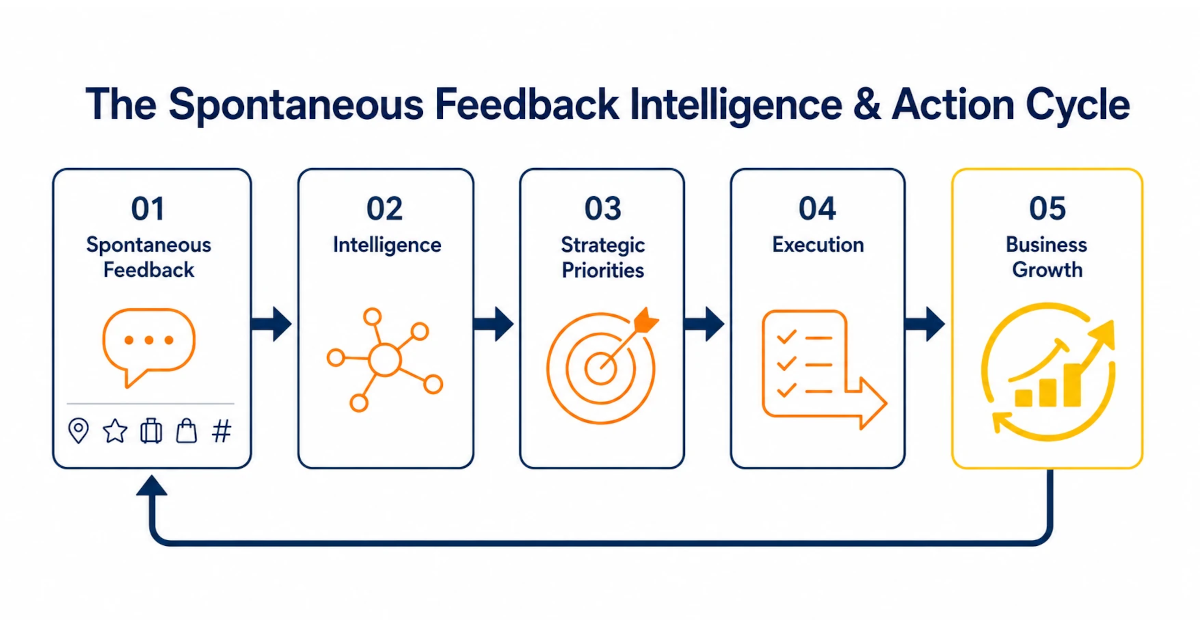
The Spontaneous Feedback Intelligence & Action (SFIA) cycle connects public customer feedback with intelligence, strategic priorities, execution and continuous business improvement.
Public guest reviews from five São Paulo hotels reveal recurring positive and negative patterns connecting human interaction, service quality and trust.
BARUERI, SAO PAULO, BRAZIL, November 3, 2026 /EINPresswire.com/ -- Yellow Tokens has released findings from an analysis of public guest feedback from five urban hotels in São Paulo, Brazil, identifying recurring relationships among empathy, service execution, experience quality and customer trust.
The analysis examined substantive public guest reviews from selected hotels in the Ibirapuera area and nearby neighborhoods. Rather than attempting to represent the entire São Paulo hotel market, the research focused on identifying behavioral patterns within the feedback available for the selected properties.
Using the Yellow Tokens Marketing Engine, the company identified two complementary patterns.
The first, internally labeled "Empathy-Driven Service Execution as Trust Multiplier," connected positive expressions of empathy with experience quality and effective service execution.
The second, "Operational Failures Amplified by Empathy Deficit," connected service execution problems with negative value perceptions and perceived lack of empathy.
Together, the patterns suggest that hotel guests do not necessarily evaluate operational performance and human interaction as separate dimensions of their stay.
"When guests describe a strong hotel experience, they often talk about both what worked and how people treated them," said Bruno Pomeranz of Yellow Tokens. "The same relationship appears in the opposite direction. An operational problem can become much more significant when the guest also feels ignored, poorly treated or unsupported."
In the positive pattern, guest narratives included attentive employees, personalized recommendations, responsiveness to requests, comfortable environments and service interactions that made the experience feel more memorable.
The feedback suggests that strong human interaction can coexist with minor imperfections without necessarily dominating the guest's overall assessment.
One type of review, for example, described an employee providing attentive recommendations that improved a dining experience. Other reviews combined positive comments about rooms, organization or location with explicit recognition of helpful and attentive staff.
The negative pattern showed the inverse relationship.
Guest feedback associated operational problems such as maintenance concerns, inconsistent room quality or weak service execution with complaints about cold, indifferent or unhelpful interactions.
Some narratives also connected those experiences with questions about whether the hotel represented fair value compared with nearby alternatives.
Yellow Tokens does not interpret these findings as evidence that empathy directly causes loyalty or that lack of empathy causes customer loss.
Instead, the analysis identifies recurring relationships in how guests describe their experiences.
The distinction is important because traditional operational analysis can treat maintenance, cleanliness, front-desk service and value perception as separate issues.
Spontaneous guest feedback can reveal that customers experience these dimensions simultaneously.
A maintenance problem may remain primarily operational when staff respond effectively and acknowledge the guest's situation. When the same type of failure is accompanied by poor communication or perceived indifference, the resulting narrative can expand into broader judgments about trust, value and the overall relationship with the hotel.
Conversely, positive human interactions can become part of how guests explain why an experience felt differentiated, reliable or worth recommending.
The findings were generated through the Yellow Tokens Marketing Engine, an evidence-grounded intelligence system designed to identify recurring behavioral relationships in public customer feedback.
The system classifies feedback into structured signals, analyzes how those signals occur together and connects higher-level patterns back to supporting customer evidence.
The São Paulo hotel analysis illustrates how the same methodology can be applied to a focused market rather than only to large cross-industry datasets.
Yellow Tokens describes this approach as part of Spontaneous Feedback Intelligence & Action (SFIA), a framework that connects voluntarily published customer feedback with structured intelligence, prioritization and continuous improvement.
The company plans to continue applying the methodology to additional hospitality markets and other industries to examine where behavioral patterns repeat and where local market dynamics produce different results.
ABOUT YELLOW TOKENS
Yellow Tokens is a software company focused on transforming spontaneous public customer feedback into structured intelligence, priorities and action. Its platform combines structured analysis and artificial intelligence to identify recurring patterns, support competitive analysis and help organizations connect customer signals with continuous improvement initiatives.
BRUNO POMERANZ
Yellow Tokens
support@yellowtokens.com
Visit us on social media:
LinkedIn
Instagram
Facebook
YouTube
TikTok
Legal Disclaimer:
EIN Presswire provides this news content "as is" without warranty of any kind. We do not accept any responsibility or liability for the accuracy, content, images, videos, licenses, completeness, legality, or reliability of the information contained in this article. If you have any complaints or copyright issues related to this article, kindly contact the author above.
